|
Stacey Mundo from Imagine School at Town Center has created an AMAZING resource: http://rtiatistc.wordpress.com/ a great place to start finding intervention resources! http://www.interventioncentral.org
Having Trouble with Progress Monitoring? Check out the resrouces at: http://www.studentprogress.org/weblibrary.asp
Create forms and such and find other links on this blog: http://rtiistc.wordpress.com RTI Manual Avaliable at the link below: http://floridarti.usf.edu/resources/tools/ta_manual/ta_manual.pdf Response to Intervention News | |||
|
RtI ~ Response to Intervention
a focus on Tier 1:
"Let us put our minds together and see what life we can make for our children."
Sitting Bull Tatanka-Iyotanka (1831-1890)
• Direct Measures of Specific Skills
• Multi-Intervention Tiered Model of Service Delivery
• Assessment Collected
• Use of Collaborative Problem Solving
• Multiple/Ongoing Data Points to Make in Data Decisions
• Systems Approach to Variables Problem Solving
• Focus on Alterable Variables
• Focus on “How”/Solutions
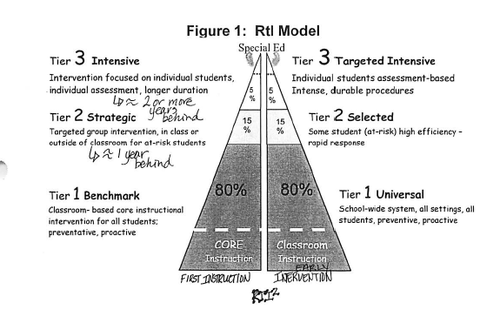
INTERVENTIONS THAT OCCUR IN THE CLASSROOM, DELIVERED BY HIGHLY QUALIFIED EDUCATORS MAKING INSTRUCTIONAL DECISIONS ABOUT TEACHING MATERIALS, INTERVENTIONS AND STRATEGIES
including:


|
StepstoSuccess.pdf Size : 257.012 Kb Type : pdf |

*Professional Develeopment
What great Teachers Do Differently by Todd Whitaker
Teach like Champion by Doug Lemov
The Passionate Teacher by Robert Fried

|
Book study Conversation Guide.doc Size : 0.032 Kb Type : doc |
|
|
Book Study Guidelines & Registration Form.doc Size : 0.058 Kb Type : doc |
*Classroom Management
|
|
checklist.pdf Size : 0.362 Kb Type : pdf |
|
|
Affirmations.pdf Size : 1.546 Kb Type : pdf |
*Precise First Instruction
|
Response to Intervention News September 8 | |||
|
Steps in Implementing This Intervention
Step 1: Select One or More Group Rewards. In this intervention, students will earn a point every time that they successfully praise a peer when you call on them. Decide how many points (e.g., 100) the class must earn collectively in order to be able to cash them in for a group reward. (NOTE: You can use the Classwide Reward Chart form [pdf file] as a simple way to set up a classwide reward system and keep track of points that the class earns.)
Step 2: Choose Students as Particular Targets for the Intervention. Pick out at most two students in the room who appear to be socially rejected and who seek peer attention in negative ways. You will later include these students as 'regulars' on your list of students to be praised each day.
Step 3: Teach Students to Praise Each Other. Set aside 10-20 minutes to review the fundamentals of praise statements with your students. Before class, post copies of the What Is Praise? and Examples of Praise posters on the classroom wall.
- Begin the lesson by paying several compliments to students. Vary your praise. For instance, you might compliment individuals for effort (e.g. "Tom, you have the farthest to walk of anyone and yet you are always here on time. Thanks!"), behavior (e.g., "Angelina, I appreciated your helping me to straighten up the room yesterday after class."), and attitude (e.g., "Malik, it is great to have someone with your upbeat personality in this class.").
- Introduce the concept of 'praise' and define the term for students. You may want to use the following definition from the What Is Praise? Poster:
"Today we are going to talk about praise. Praise is when you say something nice about someone. People like to hear compliments about their good behavior, how hard they are working, or their appearance. When we praise others, we should always be positive and always mean what we say." Ask students to volunteer positive statements that they know their friends like to hear.
- * Present sample praise statements. Show students the Examples of Praise poster. Tell students that we can use statements like those on the poster to praise others. Read through the items on the poster. Call on students to give their own examples of praise, using items on the poster as a guide. Encourage discussion about when students might use these statements.
Step 4: Introduce the Positive Peer Reporting intervention. Tell students that they will have a chance to earn a group reward. Each day you will announce at the start of class the names of 3-5 students. Tell the students that some of the names will be changed each day, while some names will stay on the list. At the end of every day or class period, you will review the list of chosen students. For each student, you will ask for volunteers to raise their hands to offer praise statements about that person. If you call on a student and that student is able to offer a sincere and appropriate compliment about the person on the list, the class earns a point toward the group reward.
Step 5: Start the Positive Peer Reporting intervention. At the start of each day or class period, select 2-3 student names at random and add them to the names of your target students (from Step 2). Announce the list of names to the class and remind the group that they will be asked to come up with compliments for each student on the list at the end of class. (You may want to write the names of the selected students on the blackboard as an additional memory aid.)
At the end of class, review the list. For each name listed, ask students to raise their hand if they have an appropriate compliment for the student. Once an individual has received 2-3 genuine compliments, move to the next name on the list.
Tally the number of compliments given and add that number of points toward the class group reward. Post the point total earned by the class publicly to generate interest. When the class has met its cumulative point goal, give the group its promised reward and start a new group point chart.
Troubleshooting
Here are some possible problems that may arise with Positive Peer Reporting, with recommended solutions:
- Your targeted student feels stigmatized. Even students who thrive on peer attention may feel uncomfortable about having their name appear daily on the list of students to receive compliments. If you predict that this intervention strategy might be awkward for your target student, consider including his or her name on the list frequently (e.g. randomly on three of every five days) but not every day.
- Students disguise unfriendly remarks as 'compliments'. As with any other intervention strategy, students may initially 'test the limits' with Positive Peer Reporting. Sometimes they may make cutting comments about others under the guise of complimenting them (e.g., "I want to praise Sally for taking a bath today."). If you find that a student is attempting to undermine the program, meet with him or her in private. Share your concern that the student is contributing to a negative classroom atmosphere. Remind the student of the disciplinary consequences that await anyone who insults or belittles a classmate. If the student persists in making hurtful comments after your conference, avoid calling on that person to give praise and be sure to enforce appropriate consequences for any negative remarks.
- Students offer only vague praise. If students seem to struggle to give specific or meaningful praise, model for them. For instance, if a student says of a peer, "Joe looked like he was paying attention to what we were doing today", you might follow up with more specific praise: "Yes, that's right. In fact, Joe asked several good questions that got everybody talking about the topic. That's the kind of class participation that gets us involved in learning!" Also, don't be shy about letting students know when they have praised well. If you highlight and discuss positive student comments that you believe are terrific examples of praise, you can help the entire class to develop standards of quality for judging compliments.
References
- Ervin, R.A., Miller, P.M., & Friman, P.C. (1996). Feed the hungry bee: Using positive peer reports to improve the social interactions and acceptance of a socially rejected girl in residential care. Journal of Applied Behavior Analysis, 29, 251-253.
Wright, J. (2002). Kids as reading helpers: Peer tutor training manual. Available: http://www.interventioncentral.org/htmdocs/interventions/rdngfluency/prt...
